The Year-One Startup Marketing Playbook: What's Essential and What to Ignore
Here is the realistic, high-impact marketing roadmap every startup needs to grow in its first year.
You’ve built the product, secured initial funding, and launched your brand to the world. Now comes the hard part: getting real customers to care, click, and convert.
Most founders envision startup marketing as a strategy that is made up of viral campaigns, multi-channel ad strategies, and enterprise-level ad platforms. One example that comes to mind is Cluely's YouTube video series that makes startup culture look like episodes of The Real World (with the crowd favorite character Ling Long).
The reality of trying to copy this strategy is that it's like playing he lottery. If you're trying to run a mature marketing strategy in your first year, you're putting yourself on the fast track to burning cash at an astronomical rate and burning out your team.
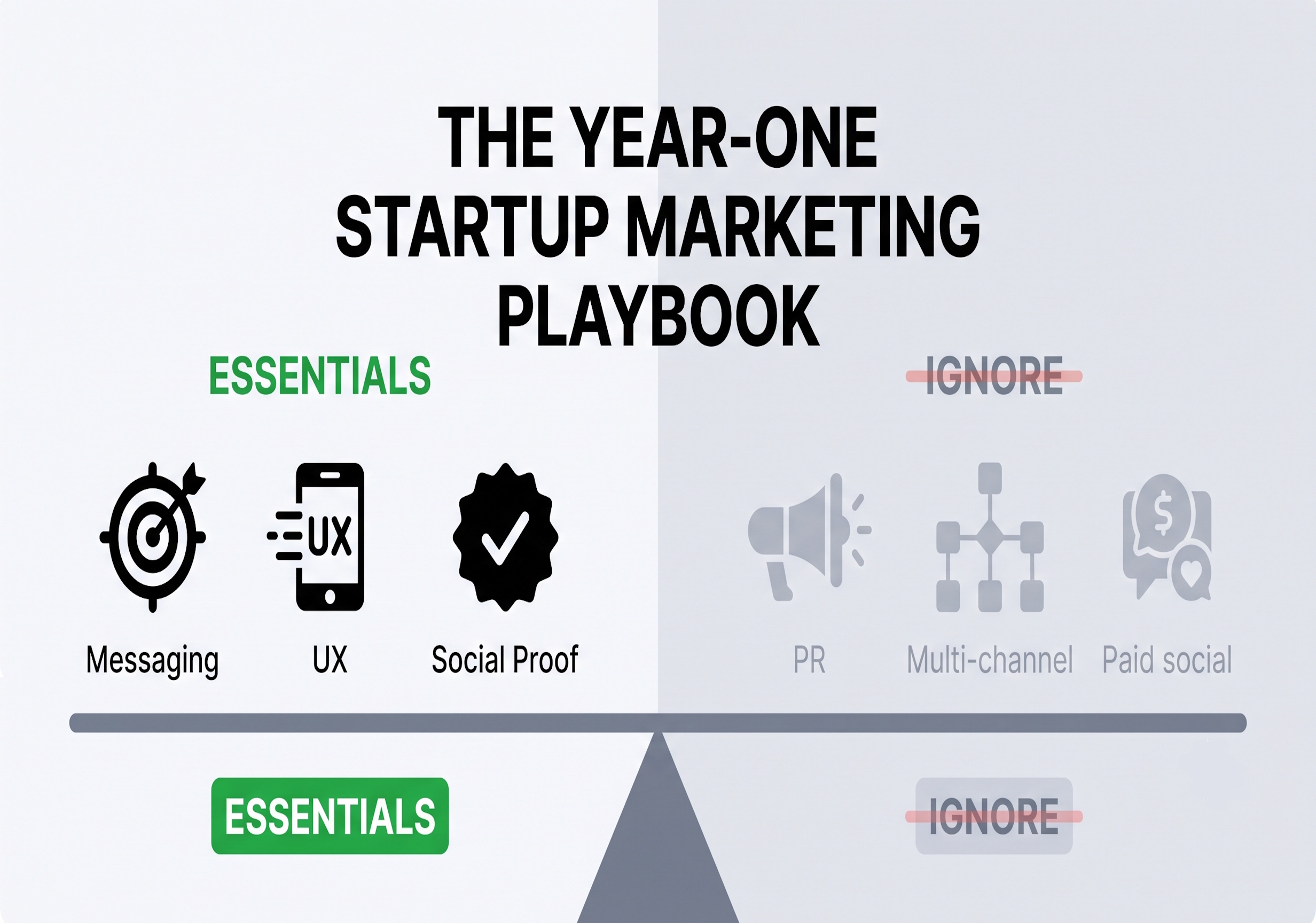
In year one, your startup marketing strategy needs to be hyper focused. Here is the Propel Collective's blueprint for any startup looking to build momentum and drive sustainable revenue in its first 12 months.
1. Radical Clarity on Product-Market Fit Messaging
Before you spend a single dollar on paid acquisition, you need to make sure your messaging is compelling and unique. Most early-stage startups fail not because the product is bad, but because the value proposition is either buried under technical jargon or is missing completely. Remember the iPod? Its core positioning statement of "1,000 songs in your pocket" was extremely effective at driving sales because it made it easy for everyone to understand what exactly 5GB of storage offered by giving them a real life comparison.
When a visitor lands on your homepage, they should understand three things in under five seconds:
- What problem you solve
- Who you solve it for
- Why your approach is better than what they're doing now
As you draft your marketing materials or write your web copy, ask yourself this simple question: If your parents read the headline and top section of your website, could they explain what your company does to their friends in one sentence? If not, you're not ready to launch any paid marketing campaigns and you must fix your messaging first.
2. A High-Converting, Frictionless Website
Your website is the single most important asset in your year one strategy. Every email outreach campaign, social post, and referral link will lead back to your site, and if your site doesn't explain what you do or why customers should choose you, your marketing efforts not be effective.
Instead of building a 30-page website to capture every keyword under the sun, focus on a lean structure optimized for conversion:
1) Fast Load Times and Mobile Usability: Over half of B2B and B2C discovery happens on mobile screens. A slow or clunky mobile experience destroys trust instantly. It's also the environment that Google crawls to determine search rank and you will be penalized if your mobile UX is poor.
2) Clear, Single-Action Calls to Action (CTAs): Don't confuse visitors with six different CTAs. Tell them exactly what step to take next, whether that is "Book a Demo," "Start Free Trial," or "Schedule a Discovery Call."
3) Social Proof: Early buyers carry risk when choosing a new startup over an established company to solve their problems. Display real customer quotes that can be verified, client logos, case studies, and/or verified third-party feedback (from G2, Clutch, Google...etc) prominently across your conversion pages.
3. Stick to One Reliable Organic Channel and One Direct Channel
One of the biggest traps founders fall into is trying to be everywhere at once: posting on LinkedIn, running Meta ads, launching a podcast, building an SEO engine, hammering IG, and taping videos for TikTok all in Q1.
In year one, narrow your focus to two channels, making sure to choose those channels based on where your audience spends most of their time:
- One Primary Organic Channel: Choose the platform where your target buyers are actively looking for solutions to their problems. For B2B startups, this is usually posting targeted SEO content on your site, amplified on LinkedIn. For B2C, it might be Instagram, YouTube, or TikTok. Spend your time producing high-value, educational content that solves real problems, not just content for vibes.
- One Direct Outbound/Direct Response Channel: Build a direct bridge to your market through personalized email outreach, strategic account-based marketing (ABM), or targeted paid search to capture high-intent buyers looking for your solution right now.
By mastering two channels, you make the best use of your time, get predictable feedback and can easily measure what works and what doesn't before you scale into a complex multi-channel marketing strategy.
4. Focus on Hard Metrics
In your first year, website impressions, social followers, and page views mean very little if they don't translate into meaningful revenue.
Your year one marketing metrics should center around learning:
- What messaging angle drives the highest click-through rate?
- Where are visitors dropping off in your sign-up or booking funnel?
- What specific objections do sales leads raise during discovery calls?
Setting up basic, reliable tracking from day one not only gets you the information you need to create an informed marketing strategy, it saves you time and money in the long run when you do launch a multi-channel marketing effort. Use tools like Google Analytics 4, heatmaps and site tracking (PostHog is great for this), and a CRM so can you make data-backed decisions instead of relying on your gut feeling.
What to Ignore in Your First Year
Just as important as knowing what to build is knowing what to say no to. In your first 12 months, avoid wasting time and budget on:
- Massive Paid Social Campaigns: Running broad Meta or TikTok ads before your messaging and landing page conversion rates are proven will only burn capital
- Complex Multi-Channel Funnels: You don't need a podcast, a newsletter, three social platforms, and a webinar funnel simultaneously. Pick one organic and one direct distribution channel and master it
- Over-Engineered Tech Stacks: Skip expensive, enterprise-grade marketing automation tools. You don't need them at this stage. Simple, lightweight setups like basic Google Analytics, a lean CRM, and a fast CMS are more than enough for you and will keep down your software costs.
- Vanity Press Releases: Paying thousands for PR distribution rarely drives qualified leads or revenue for early-stage startups. If you must, only do this at launch or when you score a partnership with a blue chip company. Do not use press releases to announce new product launches in your first year.
Build for Momentum
Marketing a startup in year one is about building a clear, repeatable growth engine that turns curious prospects into eager early adopters. Focus on positioning clarity, a seamless website experience, and tight content distribution, and you will have the foundation you need for exponential growth in year two.