The Most Common Technical SEO Errors Small Business Websites Make
Your website can look great and still be invisible to Google

What Google is actually checking when it crawls your site
Most small business owners assume that if their website looks good and has decent copy, Google will find it. That assumption is costing them new business.
Search engines don't just read your content. They crawl the underlying structure of your site to determine whether it's trustworthy, fast, and organized enough to recommend to searchers. When that structure has problems, and on most small business websites it does, Google either ranks you lower than you deserve or ignores you entirely.
These are the five technical SEO errors we find most often, why they matter, and what each one looks like when it's affecting your site:
1. Slow page speed
Page speed has been a confirmed Google ranking factor since July 2018, and it matters even more on mobile. A site that takes more than three seconds to load loses a significant portion of visitors before they've seen a single word on your site.
The most common causes for slow load times on small business sites are uncompressed images, too many third-party scripts running on page load (such as chat widgets, booking tools, and analytics tags), and choosing a website hosting plan that wasn't built to handle web traffic at any real volume.
How it costs you: High bounce rates on pages that should be converting new business. Visitors who land and leave before the page finishes loading send an immediate signal to Google that your site isn't worth recommending.
2. Duplicate content
When the same content exists across multiple pages on your site, Google has to guess which page to rank. It usually picks wrong, or splits the ranking signals between both versions, which means neither ranks as high as it should.
This happens more often than most site owners realize. Your homepage may be accessible at yourdomain.com, www.yourdomain.com, and yourdomain.com/index. Three separate URLs serving identical content dilutes the signal you're trying to send Google and sends its crawlers in the wrong direction.
The fix involves canonical tags, which are directives that tell Google which version of a URL is the one to rank, but first you have to know the duplicate URLs exist.
How it costs you: Your site isn't being shown on Google for clear, low-competition keywords and search terms. The content is there, but it's being split across multiple versions of the same page and Google can't choose which one to rank highest.
3. Missing or broken metadata
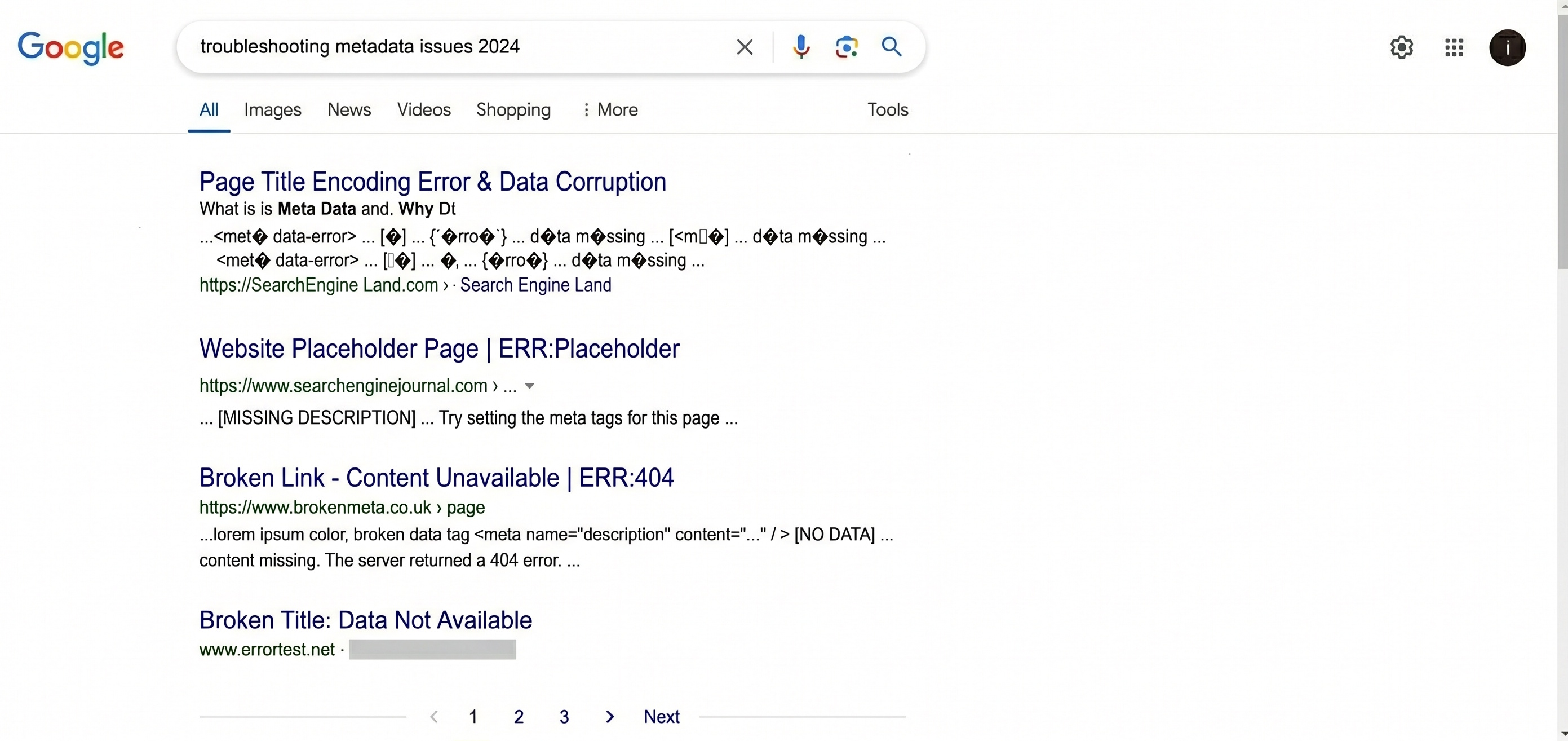
Title tags and meta descriptions don't directly move your rankings, but they determine whether someone clicks on your result when it does appear on Google. When a page on your site doesn't have a title tag or meta description, a generic label and random excerpt is put in its place, and it may have nothing to do with what that page actually covers.
The most common cause is a template that was copied and never updated; every service page showing the same title, or every title tag showing nothing but the business name.
How it costs you: You're appearing in results, but the information underneath those results isn't compelling enough to earn the click.
This is what a site with broken metadata looks like on Google
4. Your site isn't mobile-optimized
Google uses the mobile version of your site as the primary basis for crawling, indexing, and ranking. If your mobile experience is broken (text too small to read, buttons too close together, content wider than the screen), Google is making ranking decisions based on that broken experience, not the desktop version that looks fine on your laptop.
Most small business owners build and review their sites on a desktop and never check what their customers are actually seeing on their phones. Your site's mobile experience should never be a secondary concern; it is the version Google is using to decide where you rank.
How it costs you: Most searches for local services begin on someone's phone. If a potential customer clicks your link and lands on a site that's hard to read or navigate, they'll leave and go to a competitor. You got the click and lost the customer, and Google noticed.
5. Broken links and redirect chains
Every 404 error is a dead end for both users and search engine crawlers. When Google follows a link and hits a page that no longer exists, it wastes crawl budget and loses the authority that link was meant to pass.
Redirect chains create a related problem. When a URL redirects to another URL that redirects to another URL, the authority signal weakens at each step. A chain of three or more redirects can lose enough signal to significantly affect your search ranking.
How it costs you: You spent dozens of hours and hundreds or thousands of dollars redesigning your website or updating a few pages. Those pages used to rank, but now they've quietly disappeared. You lost the time, the money, and your place on Google.
Why this matters more than your content strategy or website design
Most small business owners spend significant time and money making sure their site looks professional, then wonder why it isn't showing up on Google. It's because the issues that determine your search visibility have nothing to do with how your site looks.
Content strategy gets most of the attention in SEO conversations, and for good reason; what you say matters. But content sitting on a technically broken site is like a well-written sign sitting in a window with the curtains drawn.
Most of these errors are fixable without a full site rebuild. Our Website Fixes and Optimization service is built specifically for that; we deliver targeted repairs that address what's broken without touching what's working well.
Not sure which of these apply to your site?
A Site Diagnostic with Propel Collective gives you a written assessment of exactly what's broken, what's missing, and what to fix first. It is always specific to your site and never a generic checklist, so you'll know exactly where to focus.
Your site has a reason it isn't ranking. Find out what it is by scheduling a call with us today.
Building a new site or thinking about a redesign?
Every website we build at Propel Collective is audited against these technical requirements before it goes live. Page speed, mobile optimization, canonical structure, redirect integrity; we make sure it's all taken care of before the site launches. See how we build sites that rank