What Is AEO (Answer Engine Optimization) and Should Small Businesses Prioritize It?
Your customers are asking AI tools full questions instead of typing keywords into Google. Here's how that can impact your business.
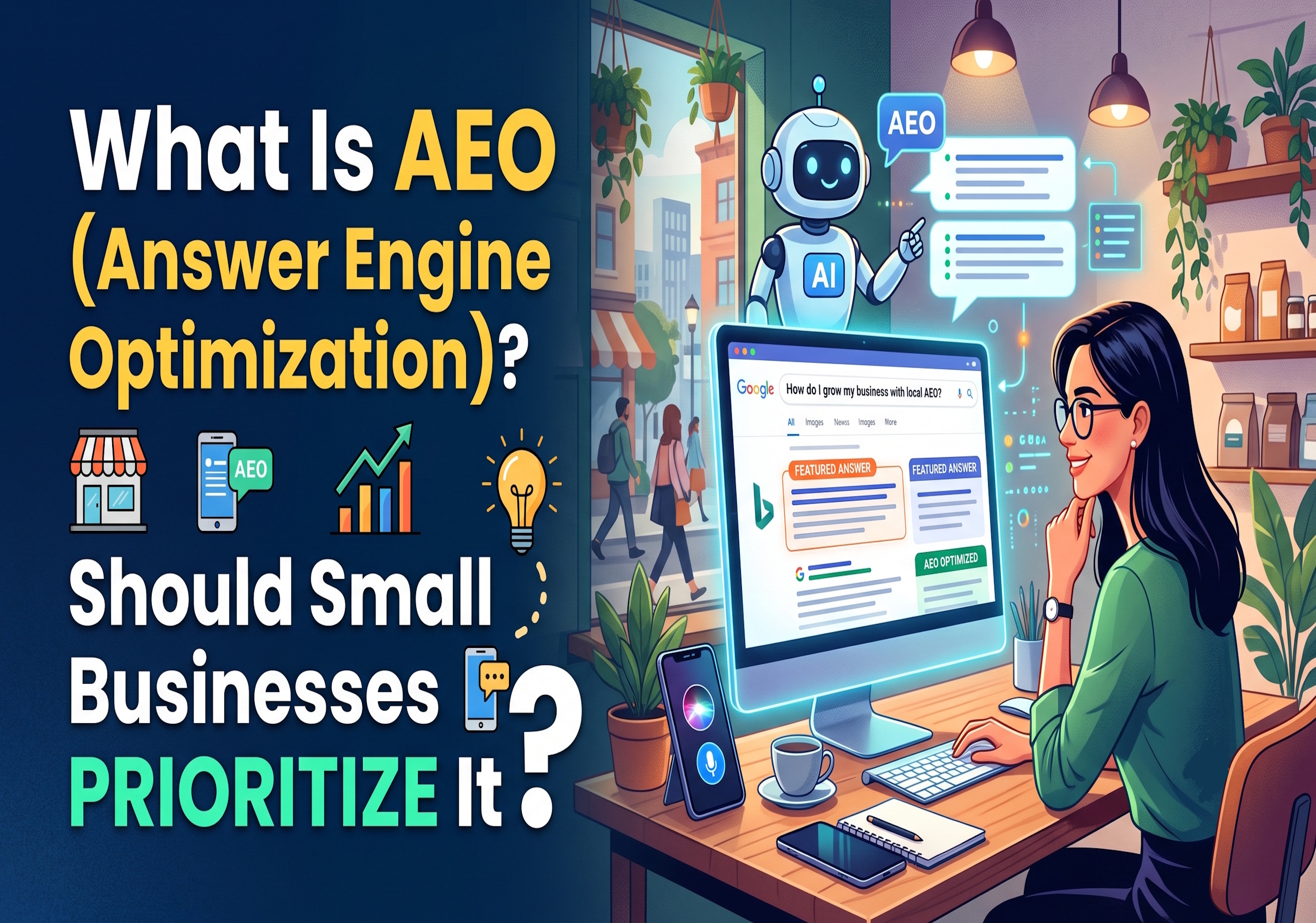
You've definitely seen the term "AI" everywhere lately: in the news, on billboards and buses when driving through San Francisco or LA, or maybe you've heard it from a vendor pitching you a new product for your business operations.
What you may not have heard that much about, is a related term called AEO, or Answer Engine Optimization. If you've been pitched by a marketing agency, they'll often refer to it as "the new SEO" and stress urgency around how you need to act fast and sign up for their service or risk disappearing from the internet. Just know, that's a sales tactic and it's not a pants-on-fire emergency (but something to still be aware of).
Here's a little bit more about AEO so that you can understand what it is and whether it's something that can and is affecting your business' growth.
What AEO actually is
To refresh ourselves on the "old" method: Search Engine Optimization (SEO) is the practice of matching what's on your business's website to a string of keywords that someone searches for on Google like "contract lawyer near me."
On the other hand, Answer Engine Optimization is the practice of making your business easy for AI tools such as ChatGPT, Claude, Google's AI Overviews, or Gemini to find, understand, and recommend when someone asks a relevant question.
AEO optimizes for a direct answer so when someone asks ChatGPT "I'm starting a business do I need a contract lawyer" or "how much does a contract lawyer charge per hour" the AI tool pulls this information from a mix of sources, summarizes them, and sometimes names specific businesses
Now, instead of whether your website has the right keywords in its copy, it's all about whether an AI system, when it creates an answer for its user, has clear, accurate, citable information about you to draw from.
This is a newer conversation
A few things have changed since the initial launch of ChatGPT a few years ago:
- AI answer tools have gone from a novelty to a daily habit for a meaningful chunk of consumers, especially for research-heavy purchases
- Google now shows AI-generated answers above traditional results, which can reduce the number of clicks to websites that rank well on Google's search
- The "sources" these tools cite aren't chosen the same way search rankings are. Clear, structured, well-organized content on a website seems to get pulled more often, but the exact mechanics aren't public or fully understood
That last point is worth remembering. AEO is still a young, immature field of practice and anyone telling you they have a fully cracked formula is overselling.
As a Small Business Owner Should I Prioritize AEO?
Like we said earlier, it's not an emergency that needed to be dealt with yesterday, but you should absolutely not ignore it.
Here's some recommendations that you can apply to your business:
Prioritize it sooner if:
- Your customers have to do real research before buying; comparing options, reading reviews, asking "what should I look for" type questions (specifically for financial services, health/wellness, legal, high-ticket home services, B2B).
- You're already investing in developing content for your website or anywhere else online
- Your category is one where AI tools are already answering questions confidently. You can test this yourself by asking ChatGPT or Claude a few questions a prospective customer might ask to see if you or your competitors show up at all.
It can wait if:
- Your business is hyper-local and impulse- or proximity-driven (most walk-in retail, most quick-service restaurants, a lot of home repair). For these, Google Business Profile, reviews, your website, and local search still do the heavy lifting, and will for a while
- You don't yet have basic SEO fundamentals in place such as a decent website, accurate business listings, or real customer reviews. AEO is not a shortcut around those
- You don't have the bandwidth to add another marketing initiative right now. A half-done AEO effort will end up pulling attention from things that have a clearer, faster payoff
It's hard to measure
Right now, there's no reliable way to track how many customers bought your product or service after searching on an AI answer engine without asking them explicitly. You can see on tools like Google Analytics or PostHog how many people came to your website from AI, but attributing purchases from that channel is still difficult.
None of this means the work isn't worth doing. It just means you should go in with realistic expectations about what you can and can't prove, and not let anyone frame this to you as a solved, trackable channel yet.
If you do want to start, start small
Here's a few small, free things that you can do to get a head start:
- Answer real questions directly on your website, in plain language. The easiest way to do is this with an FAQ page or service pages that state clearly what you do, who it's for, and what it costs
- Keep your business information consistent everywhere. That means your website, Google Business Profile, directories, and social should be up-to-date with the most accurate information. Conflicting details make it harder for any system, human or AI, to trust your business and its services
- Get more real, specific reviews. AI tools lean heavily on reviews about you from other places, not just your own website.
- Use structured data on your website (schema markup) where it's easy to add it helps machines parse what your content actually says. This is a technical fix and we can help
- Test your own visibility periodically. Ask the major AI tools questions a prospective customer would ask. It's the closest thing to a free audit you have right now.
One caveat to number five: AI is prone to hallucinations, and I just had a conversation with a client who sent me a screenshot of him searching for himself on Google Search's AI. His information was accurate, but his picture was incorrect. After a few refreshes the correct combination came up. AI has real trouble linking images to text, so if the image is wrong but the description about your business is correct, you'll be fine.
Bottom line
AEO isn't a fad, and it isn't a fire drill either. It's an emerging layer on top of the fundamentals that already matter: a good website, real reviews, clear information about your business and services, and content that answers real questions. If your customers do extensive research before they buy, it's worth starting now, in small, low-risk ways. If they don't, put your time into the fundamentals first; you'll need them either way.